Full explanation
Overview
A manufacturing machine that cost six hundred thousand euros is not selling the way it used to. The question is whether an impairment loss is needed — and if so, exactly how much. Here is the IAS 36 calculation from start to finish.
Manufacturing equipment CGU
The asset is a manufacturing cash-generating unit. Carrying amount at year-end: six hundred thousand euros. A potential buyer has offered five hundred thirty-two thousand, and disposal costs are twelve thousand. The business also has internal cash-flow projections for the next four years.
Recoverable amount = higher of FVLtCD and VIU
IAS 36 paragraph 18 requires you to compare the carrying amount to the recoverable amount. The recoverable amount is always the higher of two things: fair value less costs of disposal, and value in use. You calculate both and take whichever is higher — you never assume one is higher without checking.
Offer €532,000 − disposal costs €12,000
Fair value less costs of disposal first. The offer is five hundred thirty-two thousand. Subtract twelve thousand in disposal costs. That gives five hundred twenty thousand euros.
Discount four years of projected cash flows
Value in use: take the future cash flows the asset is expected to generate and discount them at a pre-tax rate that reflects current market assessments of the time value of money and the risks specific to this asset — ten percent here. Year one: one hundred eighty thousand, discounted back gives one hundred sixty-three thousand, six hundred thirty-six. Year two: one hundred sixty thousand, present value one hundred thirty-two thousand, two hundred thirty-one. Year three: one hundred forty thousand — one hundred five thousand, one hundred eighty-four. Year four: one hundred thousand, present value sixty-eight thousand, three hundred one. Total value in use: four hundred sixty-nine thousand, three hundred fifty-three euros.
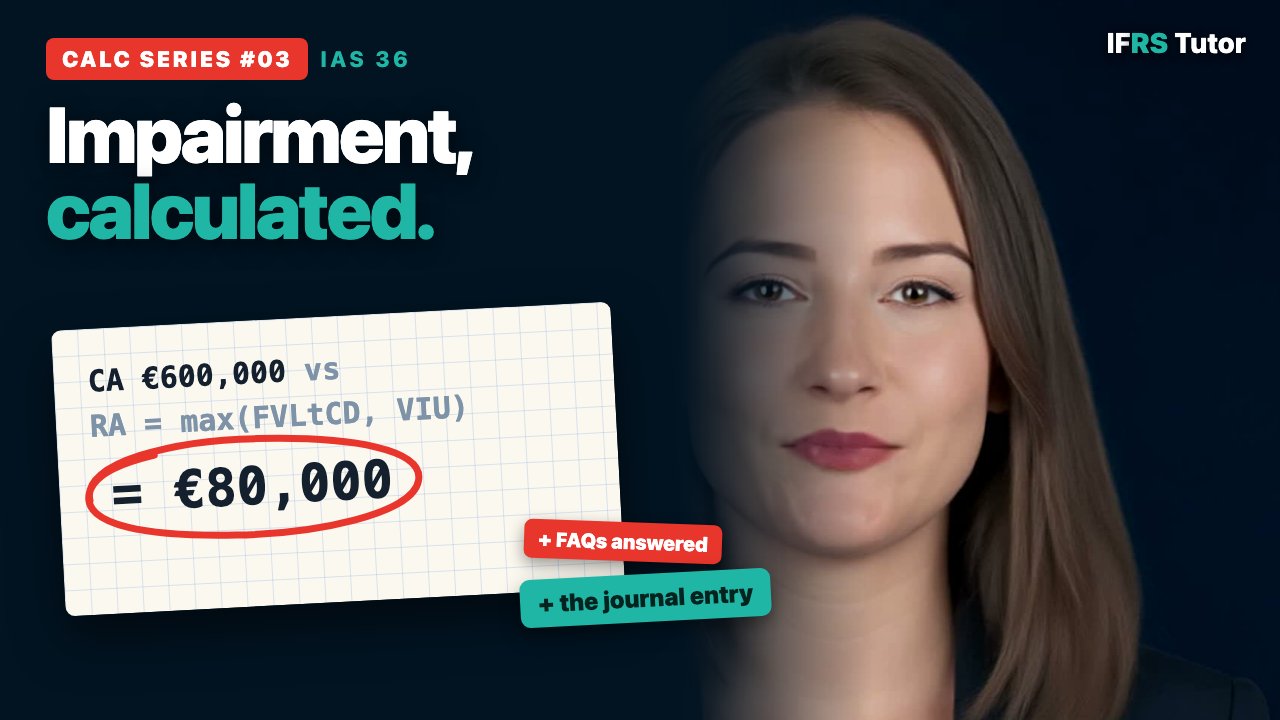
Recoverable amount = €520,000 → impairment €80,000
The recoverable amount is the higher of five hundred twenty thousand and four hundred sixty-nine thousand — so it is five hundred twenty thousand. The carrying amount is six hundred thousand. The impairment loss is six hundred thousand minus five hundred twenty thousand — eighty thousand euros. Journal entry: debit impairment loss eighty thousand, credit accumulated impairment on equipment eighty thousand.
Forgetting to check both measures
The most common slip: computing only the value in use and forgetting to check whether the fair value less disposal costs is higher. Here, the buyer's offer gives a recoverable amount of five hundred twenty thousand, while value in use only reaches four hundred sixty-nine thousand. Use only value in use, and you calculate a false impairment of one hundred thirty-one thousand instead of eighty thousand — overstating the charge by fifty-one thousand euros.
Can an impairment loss be reversed ?
Can an impairment loss be reversed? For most assets, yes — but with a ceiling. When the conditions that caused the impairment no longer exist or have reversed, you can write the asset back up. The ceiling is the carrying amount the asset would have had if you had never impaired it — that is, the original cost less accumulated depreciation from that point. You cannot write it back above that level. The reversal goes to profit or loss. One major exception: goodwill impairment is permanent. Under Eye-as 36 paragraph 124, you cannot reverse a goodwill impairment under any circumstances — not even if the recoverable amount recovers completely. That asymmetry between goodwill and other assets is one of the more tested distinctions on this topic.
Individual asset or Cash-Generating Unit ?
Do you always test individual assets, or sometimes a group? Some assets do not generate cash flows independently. A single machine on a factory floor cannot be sold and run in isolation — its recoverable amount depends on what the whole factory produces. When that is the case, you identify a Cash-Generating Unit — the smallest group of assets that generates independent cash inflows from external sources. You test the see jee you as a whole. Corporate assets such as head-office buildings and central IT systems are allocated across see jee you units in proportion to their benefit, because they support everything but generate nothing alone. The individual-asset test applies only where an asset truly produces cash flows you could assess on its own. Most real assets require a see jee you.