Full explanation
Overview
Your company just agreed to pay five hundred thousand euros for a competitor. The deal closes tomorrow. Here is exactly how to calculate the goodwill that appears on the consolidated balance sheet — and why the number depends entirely on fair value, not book value.
Company A pays €500,000 for Company B
The target company — Company B — is being acquired for five hundred thousand euros cash. On its own books, the net assets sit at two hundred sixty thousand euros. But that number is irrelevant. Under IFRS 3, what matters is what those assets are actually worth today.
Goodwill = Consideration − FV(net identifiable assets)
IFRS 3 paragraph thirty-two states the formula: goodwill equals consideration transferred, minus the fair value of the net identifiable assets acquired. Simple formula. One variable makes all the difference — fair value, not carrying amount.
Every asset remeasured at acquisition-date fair value
To get that fair value, you remeasure every identifiable asset and liability at its acquisition-date fair value. Property rises from one hundred eighty thousand to two hundred thirty thousand. Equipment falls slightly — ninety thousand down to eighty-five thousand. Inventory moves up to seventy thousand. And here is the one that catches people: a customer contracts intangible — thirty thousand euros — that never appeared on Company B's books at all. IFRS 3 requires you to recognise it because it is separable and can be reliably measured.
Property + Equipment + Inventory + Contracts − Payables
Add it all up. Property two hundred thirty thousand. Equipment eighty-five thousand. Inventory seventy thousand. Customer contracts thirty thousand. Less trade payables of seventy-five thousand. Net fair value of identifiable assets: three hundred forty thousand euros.
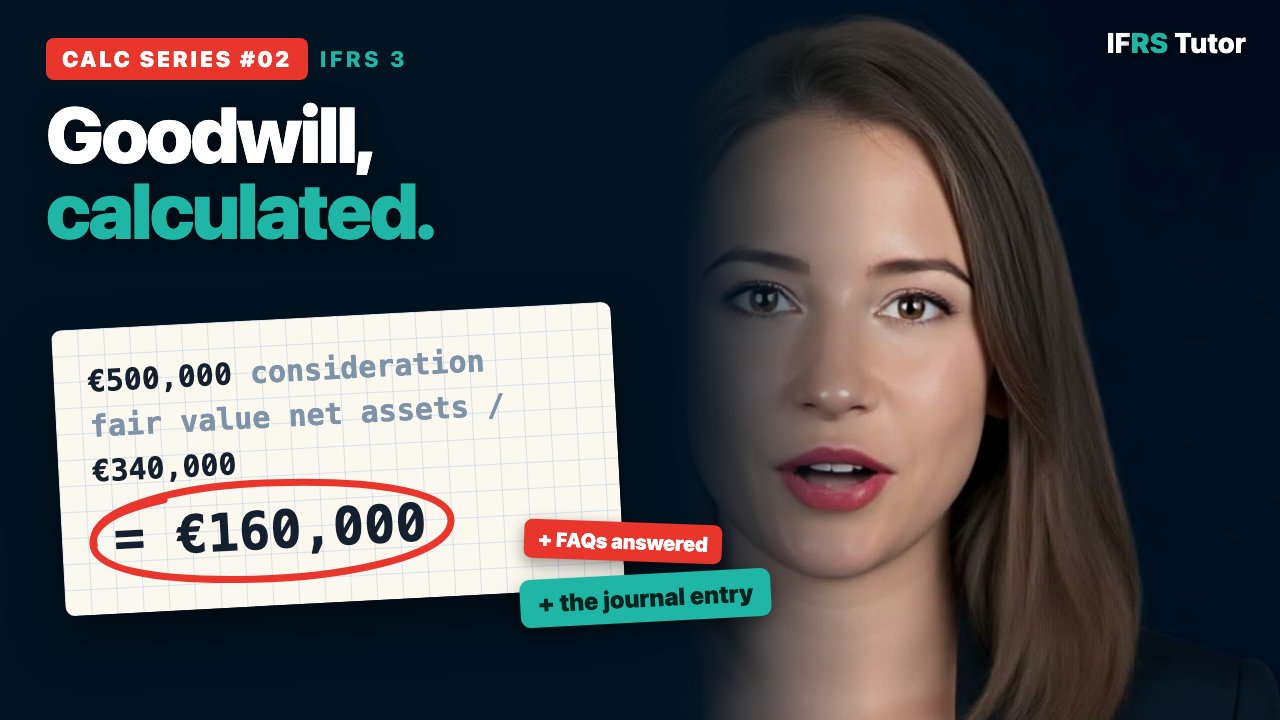
€500,000 − €340,000 = Goodwill €160,000
Goodwill is five hundred thousand minus three hundred forty thousand — one hundred sixty thousand euros. The acquisition journal entry: debit net identifiable assets three hundred forty thousand, debit goodwill one hundred sixty thousand, credit cash five hundred thousand. Goodwill is not amortised under IFRS. It sits on the balance sheet and is tested for impairment at least annually.
Using book value instead of fair value
The slip: using the book-value net assets of two hundred sixty thousand instead of fair value. That gives goodwill of two hundred forty thousand — eighty thousand euros too high. Under IFRS 3 the fair-value exercise is mandatory. Skipping it overstates goodwill on day one and inflates every impairment test that follows.
What if the price is below fair value of net assets?
What if the acquisition price is below the fair value of the net assets? That is a bargain purchase, and under Eye-fers 3 it produces a gain, not an asset. The formula works the same way: consideration transferred minus fair value of the net identifiable assets. But this time the answer is negative. Before you recognise anything, Eye-fers 3 requires you to reassess all the fair-value measurements — it assumes an acquirer rarely pays less than the value they are getting. If the negative amount survives that reassessment, recognise it immediately in profit or loss on acquisition date. You do not create a negative-goodwill intangible. You do not spread the gain forward. It goes to profit or loss in full, on day one.
Why is there no deferred tax on goodwill?
Why is there no deferred tax on goodwill? Eye-fers 3 contains a specific prohibition. The tax base of goodwill is usually zero — it is not tax-deductible in most jurisdictions. That creates a taxable temporary difference, which would normally produce a deferred tax liability under Eye-as 12. But Eye-fers 3 and Eye-as 12 together prohibit recognising that liability. The reason is circular: if you recognised a deferred tax liability on goodwill, it would increase the goodwill by the same amount. That higher goodwill would create a larger deferred tax liability, which would increase goodwill further — and so on without end. The prohibition breaks that loop. This is not the standard initial recognition exemption — it is a specific rule for business combinations.