Full explanation
Overview
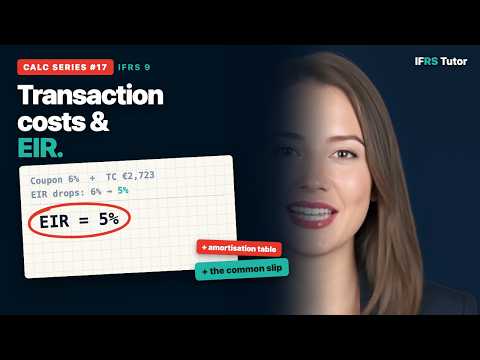
When you buy a bond and pay a broker's fee on top, IFRS 9 says that fee doesn't go straight to P&L — it goes into the carrying amount of the asset. And that single decision changes the effective interest rate for the entire life of the bond. Here's the exact calculation — and why the EIR drops from six percent to five.
Face €100k · coupon 6% · purchase price €100k + TC €2,723
Company A buys a three-year bond at par. Face value: one hundred thousand euros. Coupon: six percent — six thousand euros a year, paid annually. The bond is purchased at its face value, so the purchase price is one hundred thousand euros. Transaction costs — a direct broker fee — of two thousand, seven hundred twenty-three euros. Total cash paid: one hundred two thousand, seven hundred twenty-three euros.
TC go into the asset — not to P&L immediately
IFRS 9 paragraph 5.1.1: at initial recognition, a financial asset measured at amortised cost is measured at its fair value plus transaction costs directly attributable to its acquisition. Those costs become part of the carrying amount — not a P&L charge. They amortise over the life of the asset through the effective interest calculation. Transaction costs in — lower EIR — P&L spread over life.
Initial CA €102,723 → EIR falls from 6% to 5%
Without transaction costs, the EIR equals the coupon rate exactly — six percent — because the bond was priced at par. With transaction costs, the initial carrying amount rises to one hundred two thousand, seven hundred twenty-three euros. The EIR is the rate that discounts the three future cash flows back to that higher opening balance. Discounting six thousand, six thousand, and one hundred six thousand euros at five percent gives one hundred two thousand, seven hundred twenty-three euros. EIR: five percent.
Bond walks from €102,723 down to €100,000 at maturity
Year one: opening carrying amount one hundred two thousand, seven hundred twenty-three. Multiply by the EIR of five percent: interest income five thousand, one hundred thirty-six. Cash coupon received: six thousand. Closing carrying amount: one hundred one thousand, eight hundred fifty-nine. Year two: interest income five thousand, ninety-three — coupon six thousand — closing one hundred thousand, nine hundred fifty-two. Year three: interest income five thousand, forty-eight — coupon plus face value — closing zero. The asset amortises back to face value at maturity.
Initial CA €102,723 · Year 1 interest €5,136
At acquisition: debit financial asset at amortised cost one hundred two thousand, seven hundred twenty-three — credit cash. Year one interest: debit financial asset five thousand, one hundred thirty-six — credit interest income. Coupon receipt: debit cash six thousand — credit financial asset. Net movement on the asset in year one: minus eight hundred sixty-four. The carrying amount steps down from one hundred two thousand, seven hundred twenty-three toward one hundred thousand over three years.
Expensing TC immediately — right for FVTPL , wrong for amortised cost
The classic mistake: charging the transaction costs immediately to profit or loss — treating them the same as costs on a financial asset at fair value through profit or loss. For FVTPL assets, transaction costs are expensed. For amortised cost assets, they are capitalised. If you expense two thousand, seven hundred twenty-three in year one, you show a lump-sum loss and then record six thousand euros of interest income each year — which is the wrong number. Interest income should be five thousand, one hundred thirty-six in year one, not six thousand.