Full explanation
Why the coupon rate is the wrong rate to use
When you buy a bond at par — exactly face value — the coupon rate and the effective interest rate are the same. But bonds routinely trade at a discount or a premium to face value. If you pay €94,562 for a bond with a face value of €100,000, the difference of €5,438 is additional return that you will receive when the bond matures (or through the carry over the term). Recognising interest income at only the 3% coupon rate — €3,000 per year — ignores that €5,438. It understates income in every period and misrepresents the financial performance of the investment.
IFRS 9 paragraph 5.4.1 is clear: interest income on financial assets at amortised cost shall be recognised using the effective interest method. The effective interest method spreads the total return — coupons plus discount accretion — evenly over the life of the instrument at a constant rate on the opening carrying amount.
What the EIR is and how it's derived
The effective interest rate is the rate that exactly equates the present value of the bond's future cash flows to the bond's purchase price at the date of acquisition. For this example: a 3-year bond, €100,000 face value, 3% coupon (€3,000 per year), purchased at €94,562.
The three cash flows are: €3,000 at end of year 1, €3,000 at end of year 2, and €103,000 at end of year 3 (final coupon plus face value). The rate that makes the present value of those three amounts equal to €94,562 is 5%. That is the EIR. In practice you solve for it by iteration or a financial calculator's IRR/RATE function — the standard does not require a particular method, only that you find the rate.
The three-year amortisation table
The EIR method generates a simple but important table:
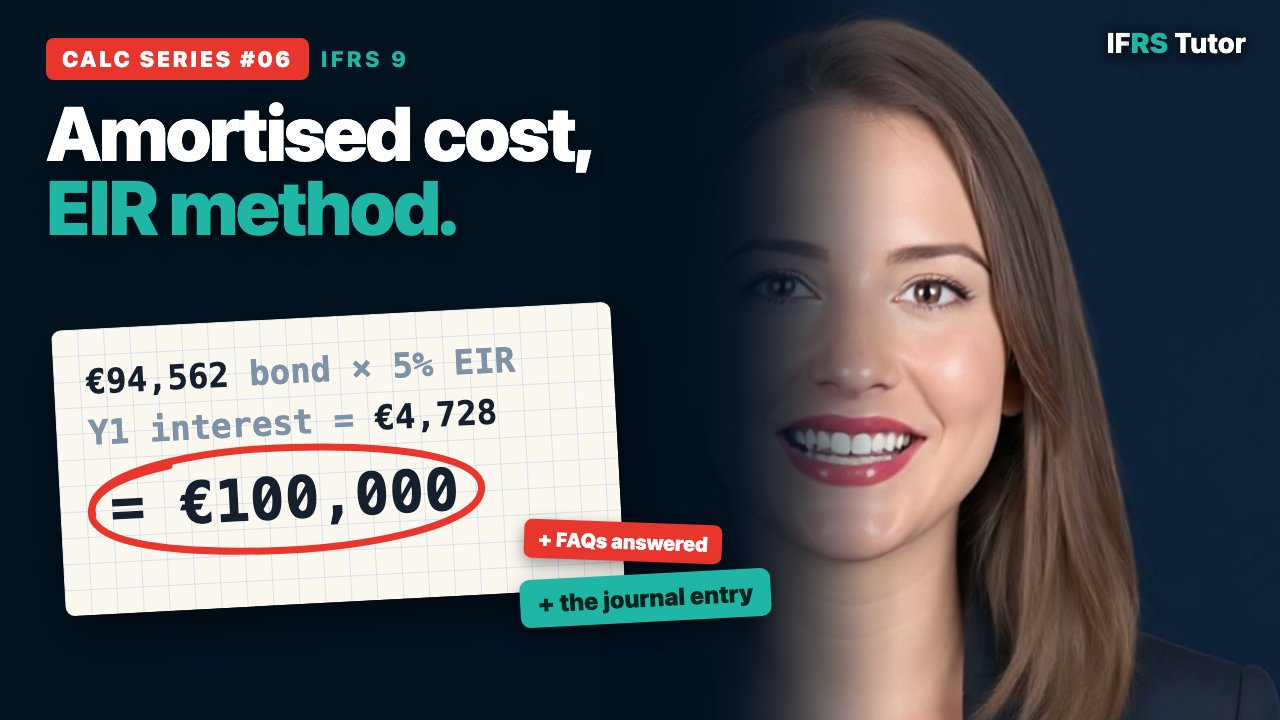
Year 1: Opening carrying amount €94,562. Interest income = €94,562 × 5% = €4,728. Cash coupon received = €3,000. Discount accretion = €4,728 − €3,000 = €1,728. Closing carrying amount = €94,562 + €1,728 = €96,290.
Year 2: Opening €96,290. Interest income = €96,290 × 5% = €4,815. Cash coupon = €3,000. Accretion = €1,815. Closing = €98,105.
Year 3: Opening €98,105. Interest income = €98,105 × 5% = €4,905 (rounded to reach €100,000 at maturity). Cash coupon = €3,000. Accretion = €1,895. Closing = €100,000 — face value recovered at maturity.
Total interest income recognised over three years: €4,728 + €4,815 + €4,905 = €14,448. Total cash received: €3,000 × 3 + €100,000 = €109,000. Total investment: €94,562. Total return: €109,000 − €94,562 = €14,438. (Small rounding differences resolve in practice.)
The journal entries
At purchase: debit financial asset (amortised cost) €94,562, credit cash €94,562.
Year 1 interest recognition: debit financial asset €4,728, credit interest income €4,728. This increases the carrying amount — the discount is accreting.
Year 1 coupon receipt: debit cash €3,000, credit financial asset €3,000. The cash coupon reduces the carrying amount back down by €3,000, leaving the net increase of €1,728 — the accretion for the year.
At maturity: debit cash €100,000, credit financial asset €100,000 — the full face value, which is now exactly the carrying amount.
The classic mistake: recognising interest at the coupon rate
The error that appears most frequently: calculating interest income as €94,562 × 3% = €2,837 in year 1 (or simply taking the €3,000 coupon as income without any accretion). The correct amount is €4,728. The understatement is €1,728 in year 1 alone. Over three years, the total understatement equals the entire discount of €5,438. By year 3, the carrying amount would still be at €94,562 instead of accreting to €100,000 — and a gain would incorrectly appear at maturity when the full €100,000 is received.
Premium bonds: the same method in reverse
If you pay more than face value — say €105,657 for a bond with a 5% coupon and a 3% EIR — the method is identical but the direction reverses. Interest income is recognised at 3% on the opening carrying amount (€3,170 in year 1), which is less than the 5% coupon received (€5,000). The excess coupon over interest income — €1,830 — reduces the carrying amount. The carrying amount declines from €105,657 toward €100,000 over the life of the bond. The amortisation table looks the same; the accretion column becomes negative.
Transaction costs change the EIR
If you paid brokerage fees of €500 to acquire the bond, IFRS 9 paragraph 5.1.1 requires those direct transaction costs to be included in the initial carrying amount. The initial carrying amount becomes €94,562 + €500 = €95,062. The EIR is now recalculated: the rate that equates the PV of the same three cash flows (€3,000, €3,000, €103,000) to €95,062 — slightly below 5%. The effect is to spread the transaction cost into interest income as a reduction to the effective yield over the bond's life. You do not expense the brokerage fee immediately; it is absorbed into the EIR.
Why the EIR method matters in IFRS financial reporting
The amortised cost measurement category under IFRS 9 applies to debt instruments that pass the SPPI test (solely payments of principal and interest) and are held within a "hold to collect" business model. Most corporate bond portfolios, intercompany loans, and trade receivables fall here. The EIR method ensures that interest income reflects the actual yield earned on the instrument — not just the cash received — and that the balance sheet always shows the economic carrying amount of the investment. It also feeds directly into the expected credit loss calculation: ECL under IFRS 9 is discounted at the original EIR for Stage 1 and Stage 2 assets.