Full explanation
When value in use is needed
IAS 36 paragraph 18 defines recoverable amount as the higher of fair value less costs of disposal (FVLCD) and value in use. You only need to calculate both if you cannot determine which is higher by inspection. But for many industrial or specialised assets — factory machinery, purpose-built equipment, infrastructure — there is no active market. FVLCD is either very low (forced-sale value in a thin market) or difficult to estimate reliably. In those cases, value in use is typically the binding measure.
In this example: a manufacturing machine with a carrying amount of €800,000. An impairment indicator has appeared — declining demand in the product line the machine supports. Management estimates the machine could be sold today for around €690,000 net of disposal costs (FVLCD). The question is whether the value in use, from continued operation, exceeds that figure — and whether either measure exceeds the €800,000 carrying amount.
IAS 36 paragraph 33: the cash flow rules
Before building the DCF table, IAS 36 sets three important rules on what can go into the forecast:
First: pre-tax cash flows. VIU is always a pre-tax calculation. The discount rate is also pre-tax. Using post-tax cash flows discounted at a post-tax rate is not equivalent — the two do not offset each other because deferred tax creates timing differences. IAS 36 paragraph 50 says the pre-tax discount rate is derived from an observable post-tax rate and then grossed up, but that grossed-up rate is applied to pre-tax cash flows, not post-tax ones.
Second: reasonable and supportable assumptions. The forecast must be based on the most recent management-approved budgets or forecasts, not on wishful projections. IAS 36 paragraph 34 requires the assumptions to represent the management's best estimate of the economic conditions over the asset's remaining useful life.
Third: no cash flows from committed restructurings or future enhancements. IAS 36 paragraph 44 is explicit: you calculate VIU in its current condition. A planned capital upgrade that would improve the machine's output is not included unless the expenditure has already been committed. This prevents VIU from embedding a free option on future investment.
The discount rate under IAS 36 paragraph 55
The discount rate must reflect the time value of money and the risks specific to the asset. IAS 36 paragraph 55 gives the practical starting point: use the pre-tax rate implicit in a current market transaction for a similar asset, or a weighted average cost of capital (WACC) for a listed entity with a similar asset profile — then adjust for asset-specific risk. The key word is "specific". A company's own general WACC is not automatically the right rate for a particular asset if that asset's risk profile differs materially from the entity's overall portfolio. A high-risk R&D-intensive machine needs a higher rate than a stable production line, even within the same entity.
In this example, a 9% pre-tax rate has been determined for the machine — reflecting the manufacturing sector, the asset's remaining life, and its specific demand-related risk.
The five-year DCF table at 9%
The five estimated annual pre-tax free cash flows from the machine, and their present values at 9%:
Year 1: €220,000 ÷ 1.09 = €201,835. Year 2: €200,000 ÷ 1.09² = €168,337. Year 3: €180,000 ÷ 1.09³ = €139,002. Year 4: €160,000 ÷ 1.09⁴ = €113,330. Year 5: €140,000 ÷ 1.09⁵ = €90,993. Terminal proceeds: €10,000 ÷ 1.09⁵ = €6,499. Total value in use: €720,000.
Recoverable amount and the impairment loss
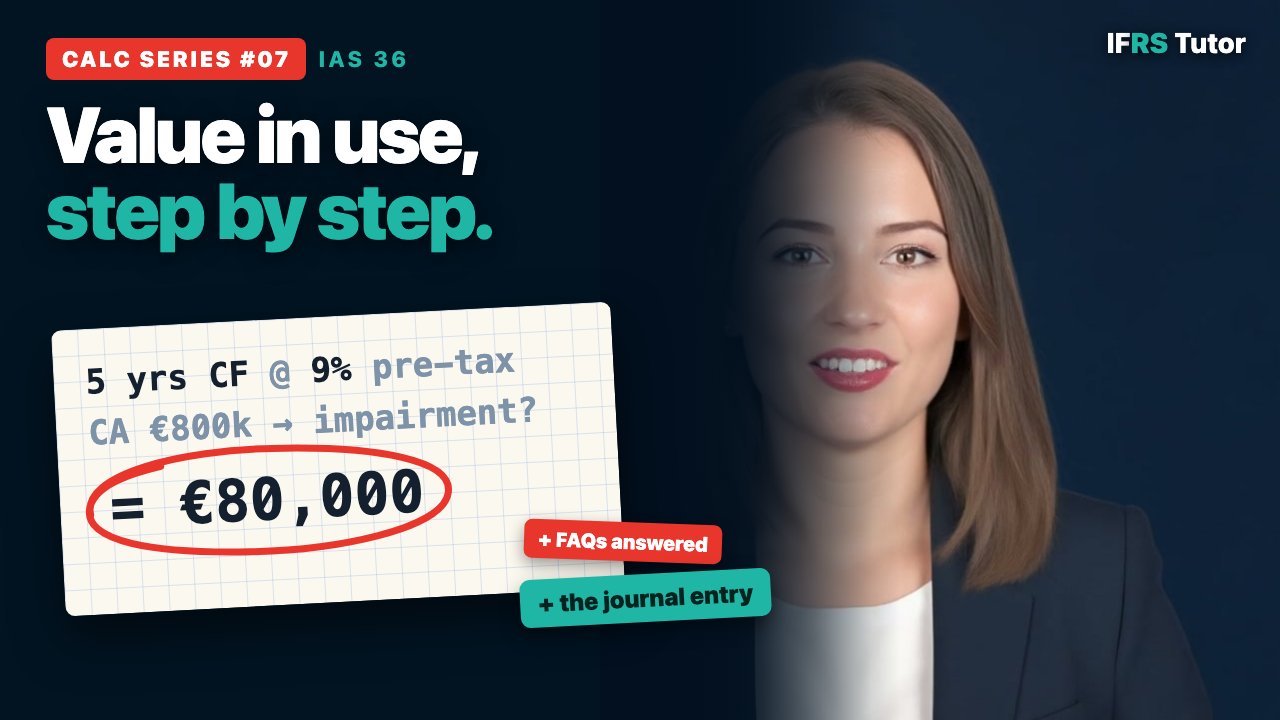
Recoverable amount is the higher of FVLCD and VIU: higher of €690,000 and €720,000 = €720,000. Carrying amount: €800,000. Impairment loss: €800,000 − €720,000 = €80,000.
Journal entry: debit impairment loss (P&L) €80,000, credit accumulated impairment losses €80,000. The asset's new carrying amount is €720,000. Future depreciation is recalculated over the remaining useful life on this new base.
Common mistake 1: post-tax cash flows with a post-tax discount rate
The most frequent error in VIU calculations is using post-tax cash flows discounted at a post-tax rate on the basis that "the two offset each other". They do not. Deferred tax creates a wedge between the pre-tax and post-tax calculation because the tax timing differences are themselves asset-specific and period-specific. IAS 36 is prescriptive: pre-tax cash flows, pre-tax rate. An auditor reviewing a VIU calculation will specifically test this point, and many audit firms have detailed guidance on how to derive the pre-tax rate from an observable post-tax benchmark.
Common mistake 2: including committed restructurings or future capital enhancements
If management plans to retool the machine for a new product line, or to invest in efficiency improvements, those cash flows — both the costs and the higher future revenues — must not be included in the VIU unless the restructuring or capital expenditure has already been committed. "Committed" under IFRS means a detailed formal plan that creates a constructive obligation, not an intention or a board presentation. The rationale: IAS 36 requires you to test the asset as it currently stands. Including uncommitted improvements would inflate VIU and prevent impairment losses that ought to be recognised.
Extending the forecast beyond five years
IAS 36 paragraph 35 sets a presumption that the detailed forecast period is limited to five years. Beyond five years, a steady-state or terminal growth rate is applied to the year-five figure — and the standard requires that rate to not exceed the long-term average growth rate for the industry or country, unless a higher rate can be justified. In practice, most impairment models use a terminal growth rate of 1–3% for stable industrial assets. The five-year limit is a rebuttable presumption: paragraph 35 allows a longer period if management can demonstrate a reliable forecasting track record. Few entities can. The risk is that extending the period introduces optimism that is difficult to audit.
Cash-generating units: when the asset cannot be tested alone
IAS 36 paragraph 66 applies when an asset cannot generate cash inflows independently of other assets. Most production machines in an integrated manufacturing plant are in this position — you cannot attribute revenue to a single machine. In those cases, you identify the smallest group of assets that does generate cash inflows independently — the cash-generating unit (CGU). The impairment test is then performed at CGU level, not at individual asset level. The €800,000 machine in this example was treated as generating independent cash flows; if it were part of an integrated line, the CGU test would replace the individual asset test.