Full explanation
Why the ROU asset and lease liability start at different amounts
Most people calculate the lease liability first — and they're right to. IFRS 16 paragraph 26 defines the lease liability as the present value of future lease payments, discounted at the rate implicit in the lease or the lessee's incremental borrowing rate. For a four-year equipment lease at €50,000 per year paid in arrears, with a 6% incremental borrowing rate, that present value is €173,255.
But IFRS 16 paragraph 24 says the right-of-use asset is something different. It starts with the lease liability — but then adds other costs the lessee incurred to obtain or prepare for the lease. The result is that the ROU asset is almost always higher than the lease liability at commencement.
The four components of ROU asset cost under IFRS 16 para 24
IFRS 16 paragraph 24 lists four items that make up the ROU asset at initial measurement:
1. The initial measurement of the lease liability — €173,255 in this example.
2. Lease payments made at or before the commencement date, less any lease incentives received. If you paid anything before the lease started — a deposit or advance — it goes here.
3. Initial direct costs incurred by the lessee.
4. An estimate of costs to dismantle and restore the underlying asset to the condition required by the lease — only where IFRS 16 paragraph 24(d) and IAS 37 require a provision.
What counts as an initial direct cost
IFRS 16 Appendix A defines initial direct costs as incremental costs of obtaining a lease that would not have been incurred if the lease had not been obtained. The word "incremental" is the test. Legal fees paid to a lawyer specifically to negotiate and document this lease: yes. Salary costs of your own in-house legal team reviewing the lease: no — those costs arise regardless of whether the specific lease is signed. Due-diligence costs on a building you then lease: no — those arise before the lease exists, not because you obtained it.
In this worked example, €2,000 of legal fees were incurred specifically to obtain the lease. They pass the incremental test and go into the ROU asset.
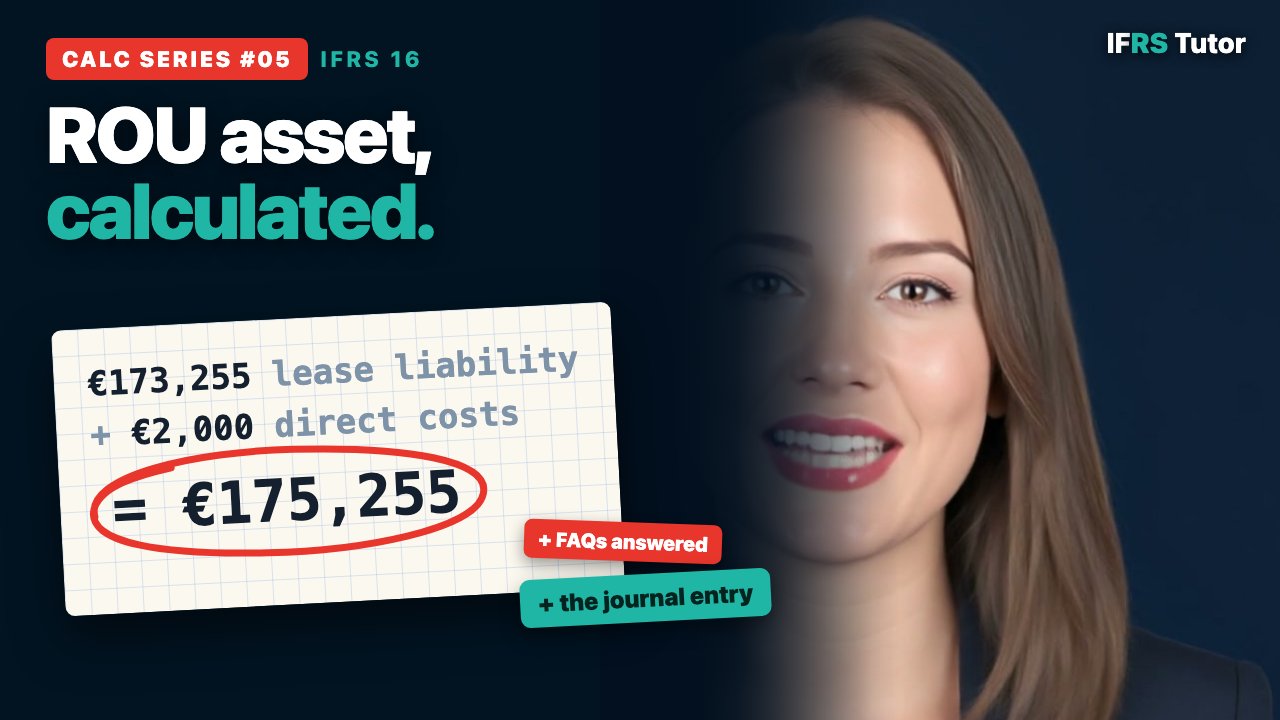
The calculation: €175,255
With the components identified, the arithmetic is simple:
Lease liability at commencement: €173,255. Initial direct costs: €2,000. No payments before commencement. No decommissioning obligation. No lease incentives received. Right-of-use asset: €175,255.
The commencement journal entry
At commencement date, two entries are needed. First, record the lease itself: debit right-of-use asset €173,255, credit lease liability €173,255. Second, reclassify the initial direct costs from cash (or prepaid expenses if already accrued): debit right-of-use asset €2,000, credit cash €2,000 (or debit ROU asset / credit prepaid if paid earlier).
In practice, these two entries are usually combined: debit right-of-use asset €175,255, credit lease liability €173,255, credit cash €2,000.
After this, depreciation runs straight-line over the shorter of the lease term and the useful life of the underlying asset — here, four years, giving €43,814 per year (€175,255 ÷ 4). The lease liability unwinds separately: interest at 6% on the opening balance, less each cash payment.
Common mistake: expensing initial direct costs
The error that appears most often in practice: taking the initial direct costs straight to profit or loss on the grounds that they feel like period expenses. Legal fees to negotiate a lease look like transaction costs, and the instinct is to expense them. But IFRS 16 is explicit — they are an asset. They represent something you paid to obtain the right to use the leased asset, and that right is the ROU asset. Expensing them immediately understates the ROU asset from day one and overstates the period expense.
Decommissioning obligations and the ROU asset
If the lease requires the lessee to return the asset in a specific condition — for example, a lessee must restore a warehouse to its original layout, or must remove leasehold improvements — IAS 37 requires a provision for the estimated cost of that restoration. The provision goes into the ROU asset cost on day one, increasing both the asset and a liability.
Say the warehouse lease requires €15,000 of restoration at the end of the term. IAS 37 says recognise that obligation now, discounted to present value. The discounted provision — say €12,000 — goes into the ROU asset. The ROU asset becomes €173,255 + €2,000 + €12,000 = €187,255. A corresponding provision liability of €12,000 is recognised separately. Over the lease term, the provision unwinds at the discount rate (interest expense in P&L), and the additional ROU asset of €12,000 depreciates along with the rest.
Lease incentives received from the lessor
If the lessor pays the lessee an incentive before or at commencement — for example, a €5,000 fit-out contribution or a rent-free period — that incentive reduces the ROU asset. The lessee deducts it from the cost at commencement. A €5,000 cash incentive from the lessor: debit cash €5,000, credit ROU asset €5,000 (or deduct in the initial measurement). The ROU asset becomes €175,255 − €5,000 = €170,255.
The treatment reflects the economics: the lessor has effectively given you part of what you need, reducing the economic cost of the right you are obtaining.
How ROU asset cost feeds into subsequent depreciation
The ROU asset depreciates from the commencement date to the earlier of the end of the lease term or the end of the useful life of the underlying asset — unless there is a purchase option the lessee is reasonably certain to exercise, in which case it depreciates to the end of the useful life. Depreciation method under IAS 16 paragraph 60 applies: normally straight-line unless another method better reflects the pattern of consumption of the asset's benefits. If the ROU asset is higher because of initial direct costs or a decommissioning provision, the higher amount is what depreciates — and that higher base flows through to higher depreciation expense each period.